Alternative Proteins – How Ingredients and Processes Shape the Next Stage of Development
Oct 19, 2026
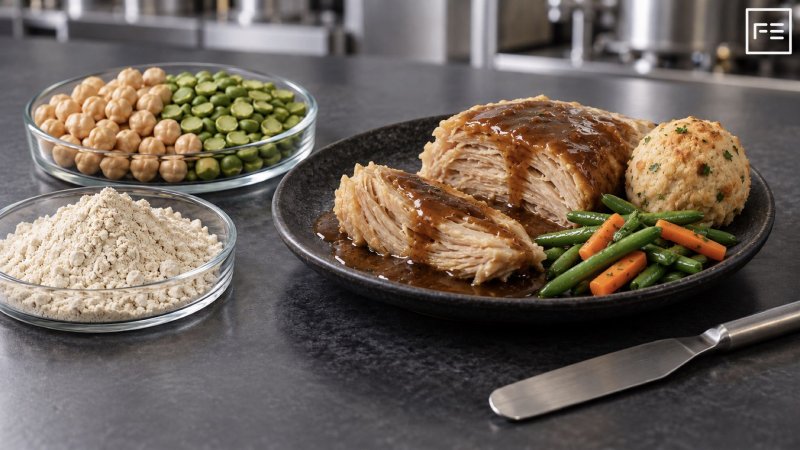
Whole pulses, functional concentrates and new production platforms offer different development pathways. What matters is which properties an application requires and how consistently a process delivers them. Requirements shift between ingredient preparation, structuring, energy supply and quality assurance.
Andreas Gebhart | Food Essentials | 18. Oktober 2026
Tofu and tempeh represent long-established ways of making food through coagulation and fermentation respectively. Industrial microbial biomass also has a history: Quorn launched its first mycoprotein products in the UK in 1985.[1] Meat-like bite, juiciness and familiar preparation subsequently became more prominent development goals. Today, improving plant-based foods and establishing new protein sources are parallel activities.
A Market Moving in Different Directions
Circana data analysed by GFI Europe show that German retail sales volume across six plant-based alternative categories increased by 6.2% in 2025 compared with 2024. Meat alternatives declined by 1.7%. The separately reported tofu, tempeh and seitan category grew by 29.7%.[2]
In September 2026, YouGov reported that almost 35% of German households had bought meat alternatives at least once. In a separate representative survey, 61% considered such products too expensive.[2] Buyer penetration and perceptions of price describe different measures. Time-series comparisons with Circana would require matching category definitions, reporting periods and panel coverage.
For development teams, this raises an application-specific market question: which product will consumers buy regularly, at what price and under which preparation conditions? A convincing prototype needs to work in everyday use. Taste, availability, cost per portion and convenience jointly influence achievable sales.
Using the Functions of the Whole Plant Matrix
Processes that combine the structural contributions of starch, protein and fibre are particularly interesting. An ETH study published in September 2026 examined directional freezing of heat-treated whole-pulse suspensions. Growing ice crystals concentrate components in aligned spaces; an oriented gel structure remains after thawing. Texture was characterised microscopically and mechanically. Industrial throughput, consumer sensory testing and comparative environmental assessment are further validation tasks.[3]
A separate 2025 experimental study investigated high-moisture extrusion of dry-fractionated faba bean and pea concentrates, alone and mixed with functional soya concentrate.[4] Its results illustrate how ingredient proportions, pretreatment and moisture content influence texture. This opens development options between whole pulses and highly purified isolates.
In Food Essentials' assessment, ingredient selection should therefore start with the required function. Higher protein content can benefit certain applications; others gain from the combined water-binding and structural effects of several fractions. Additional starch or fibre also changes flow behaviour, colour and inherent flavour. Formulation and processing must accommodate these properties.
For a sliceable product, gel formation and water binding are priorities. A beverage requires good dispersibility and stable properties during heating and storage. Ingredient specifications therefore need to follow the particular application and its processing window.
The economic assessment covers the entire processing chain. Avoiding isolation or recombination stages can reduce effort. Their value depends on the heating, cooling, drying or stabilisation required to deliver a ready-to-eat product. Saleable yield, shelf life and uses for remaining fractions also enter the calculation.
New Platforms Shift the Bottlenecks
In biomass fermentation, the grown microorganism itself forms the ingredient. Precision fermentation produces a defined target substance, such as a functional protein. Its intended emulsifying, foaming or gelling performance determines recovery and downstream-processing requirements. Three-dimensional structuring arranges food matrices spatially; development tasks include flow behaviour, structure stabilisation and consistent shaping.[5] Selection should follow the food application. In microbial processes, feedstock consistency, oxygen transfer and heat removal also determine operation. Agricultural side streams require assessment of available quantities, composition and hygienic suitability.
Gas-based protein production further broadens the feedstock base. Solar Foods' 2026 half-year report records the US launch of a protein powder containing Solein and presents Factory 02 as a planned expansion.[6] This dated market entry marks a concrete application milestone. Larger-scale production planning additionally depends on secured demand, plant financing and stable operating costs.
A modelling study of hydrogen-oxidising microorganisms illustrates resource dependencies: electricity, hydrogen, oxygen, CO₂, a nitrogen source and minerals form the production base.[6] Location, heat integration and downstream processing shape the economics. As dependence on agricultural land decreases, energy infrastructure and consistent plant utilisation gain importance.
Animal cell cultures require media suited to cell type and growth phase. Oxygen supply, gentle mixing, hygienic operation and safe harvesting must work together. A 2025 laboratory study investigated ammonia removal from spent medium and its partial reuse with lamb muscle cells.[7] Transfer to longer production campaigns requires control of nutrients, metabolites and microbiological safety.
A common material-flow assessment is useful across platforms: how much suitable ingredient reaches the finished product after harvesting, processing and storage? What quantities of media, water, cleaning agents and energy are required? The FAO/WHO assessment of cell-based foods addresses safety along these process stages.[7] Environmental and cost comparisons accordingly require consistent system boundaries.
Protein Quality and Requirements Remain Part of Product Development
Nutritional assessment considers amino acid profile, digestibility and overall composition. Protein breakdown produces urea, among other compounds, which is excreted by the kidneys. Elevated urinary protein is a separate finding requiring clinical assessment. For healthy adults, total intake should reflect requirements; long-term evidence on very high intakes remains limited. Chronic kidney disease requires stage-specific clinical recommendations.[8] A high-protein concept therefore needs a clearly defined target group.
The next stage of development emerges where ingredient function, production process and intended use align. A successful project combines the desired texture with consistent quality, viable unit costs and appropriate market access. This is central to Food Essentials' advisory approach: aligning ingredient and process selection early with product requirements, safety and commercial implementation.
Yours, Andreas Gebhart
Sources
Checked on 16 October 2026.
[1] Quorn, mycoprotein history.
[2] GFI Europe, retail data 2023–2025; YouGov/SINUS, Germany, 28 September 2026.
[3] Bach et al., freeze structuring, 2026.
[4] Elshamy et al., high-moisture extrusion, 2025.
[5] Fraunhofer IGB, alternative proteins.
[6] Solar Foods, half-year report 2026; Fasihi et al., modelling study, 2025.
[7] Pakbin et al., medium recycling, 2025; FAO/WHO, cell-based foods, 2023.
[8] DGE, protein FAQ; NIDDK, albuminuria; KDIGO 2024, Chapter 3.3.1.
Hinweis: Fachliche Einordnung, keine individuelle medizinische oder rechtliche Beratung. Produkt- und marktbezogene Prüfungen bleiben erforderlich. Bild: KI-generiert.
Ready for sustainable solutions?